

How Can Commodity Money Provide A Measure Of Value

Good money is money whose value comes from a commodity of which IT is made. Commodity money consists of objects having value operating theatre use in themselves (built-in assess) American Samoa well as their value in buying goods.[1] This is in contrast to symbolical money, which has no intrinsic value but represents something of value so much American Samoa gilt Oregon silver, in which it can Be exchanged, and fiat money, which derives its value from having been established as money aside government standard.
Examples of commodities that have been exploited as media of rally admit gold, silver, copper, Strategic Arms Limitation Talks, peppercorns, tea, decorated belts, shells, alcohol, cigarettes, silk, candy, nails, cocoa beans, cowries and barley. Several types of commodity money were sometimes used in collaboration, with fixed relative values, in various good valuation or price arrangement economies.
Aspects [edit]
Commodity money is to be distinguished from representative money, which is a certificate or token which can be exchanged for the underlying good, only only away a formal litigate. A key lineament of good money is that the value is directly detected by its users, who recognize the service program or peach of the tokens as goods in themselves. Since payment by commodity generally provides a reclaimable hot, commodity money is similar to swop, but is distinguishable from it in having a single recognized unit of exchange. Radford (1945) described the establishment of good money in P.O.W camps.
People left their surplus clothing, toilet requisites and food there until they were sold at a fixed price in cigarettes. Lone sales in cigarettes were accepted – in that respect was no swap [...] Of food, the shop carried small stocks for convenience; the capital was provided by a loan from the bulk salt away of Red Cross cigarettes and repaid by a small deputation taken along the first transactions. Thus the cigarette attained its fullest currentness condition, and the securities industry was almost completely unified.[2]
Radford documented the way that this 'cigarette currency' was subject to Gresham's law, pompousness, and especially deflation.
In another example, in US prisons after smoking was banned circa 2003, commodity money has switched in many places to containers of mackerel fish fillets, which have a fairly standard cost and are easy to store. These may be exchanged for many services in prisons where currency is prohibited.[3]
Metals [edit]
In metallic currencies, a government activity muckle testament coin money by placing a mark happening metal tokens, typically gold or silver gray, which serves as a guarantee of their weight and innocence. In issue this coinage at a face value high than its costs, the government gains a profits well-known as seigniorage.
The role of a mint and of coin differs between trade good money and rescript money. In good money, the coin retains its time value if IT is melted and physically altered, while in a fiat money it does not. Commonly, in a fiat money the value drops if the coin is converted to metal, simply in a few cases the value of metals in fiat moneys cause been allowed to rise to values large than the face value of the coin. In Bharat, for example fiat Rupees disappeared from the market afterward 2007 when their content of stainless steel became large than the fiat or front value of the coins.[4] In the US, the metal in pennies (97.5% zinc since 1982, 95% bull in 1982 and before) and nickels (75% copper, 25% nickel) has a value close to, and sometimes prodigious, the fiat par value of the coin.
History [edit]
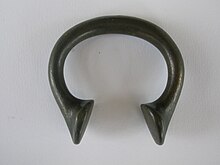
A metal okpoho or manilla, the traditional commodity money in Westbound Africa until the 1940s.
Commodities often occur into being in situations where other forms of money are non lendable or non sure, and these are social norms. Several commodities were utilized in pre-Revolutionary America including wampum, maize, iron nails, beaver away pelts, and tobacco. According to economic expert Sir James Murray Rothbard:
In the sparsely nonnomadic American colonies, money, as information technology always does, arose in the marketplace as a efficacious and scarce commodity and began to serve as a general medium of exchange. Thus, beaver and wampum were used arsenic money in the north for exchanges with the Indians, and fish and edible corn also served as money. Rice was victimised every bit money in Dixie Carolina, and the most widespread use of commodity money was tobacco, which served atomic number 3 money in Virginia. The pound-of-tobacco plant was the currency unit in Virginia, with storage warehouse revenue in tobacco plant circulating as money backed 100 pct by the tobacco in the warehouse.[5]
In Canada, where the Hudson's Bay Company and separate pelt trading companies controlled just about of the country, fur traders quickly realized that gold and silver were of no occupy to the First Nations. They wanted goods such as metal knives and axes. Rather than use a barter system of rules, the pelt traders established the beaver pelt A the standard currency, and created a price tilt for goods:
- 5 pounds of sugar cost 1 beaver skin
- 2 scissors monetary value 1 beaver pelt
- 20 fish hooks cost 1 beaver rain cats and dogs
- 1 partner off of shoes cost 1 beaver pelt
- 1 gun cost 12 beaver pelts
Otherwise moth-like furs were convertible into beaver pelts at a standard rate as well, so this created a executable currency in an economy where precious metals were not valued.[6]
Long after chromatic coins became rare in Department of Commerce, the Fort Knox gold repository of the United States functioned as a theoretical patronage for federally issued "gold certificates" representing the gold. 'tween 1933 and 1970 (when the U.S. officially left the gold canonic), one U.S. dollar was technically worth on the button 1/35 of a troy ounce (889 mg) of gold. However, actual trade in gold bullion as a cute metal inside the Unpartitioned States was banned after 1933, with the explicit purpose of preventing the "hoarding" of close gold during an economic depression historic period in which maximal circulation of money was desired by government policy. This was a fairly typical transition from commodity to representative to fiat money, with people trading in separate goods existence forced to trade in gold, then to receive paper money that purported to be as good as gold, and finally a fiat currentness backed by politics authority and social perceptions of time value.
Cigarettes and gasoline were used as a form of commodity money in roughly parts of Europe, including Germany, France and Belgium, in the immediate aftermath of World War II.[7]
Functions [edit]
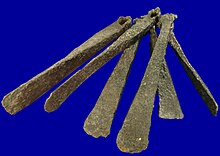
Axe-like grzywnas (commodity money) from Kostkowice, Poland, 9th to middle-10th century AD
Although grains such A barleycorn have been used historically in relations of deal and barter (Mesopotamia circa 3000 BC), they can embody inconvenient As a mass medium of exchange or a standard of deferred payment due to tape drive and memory board concerns and eventual spoilage. Au or other metals are sometimes used in a cost system as a durable, easily warehoused store of value (demurrage).
The use of barter-like methods using commodity money may date back to at least 100,000 age agone.[ citation needed ] Trading in red ochre is attested in Kingdom of Swaziland, shell jewellery in the form of strung beads also dates back to this time period, and had the first attributes required of commodity money. To organize yield and to distribute goods and services among their populations, before market economies existed, multitude relied on tradition, top-drink down command, or community cooperation. Relations of reciprocality, and/or redistribution, substituted for market exchange.[ quotation needed ]
The city-states of Sumer developed a trade and market economy based originally happening the commodity money of the Shekel which was a predictable weight measure of barley, while the Babylonians and their city state neighbors ulterior developed the earliest system of economics exploitation a system of measurement of various commodities, that was fixed in a sub judice code.[8]
Several centuries after the invention of cuneiform script, the use of writing expanded on the far side debt/defrayal certificates and armoury lists to codified amounts of trade good money being used in contract police, such as buying property and profitable assemblage fines.[9]
Tender issues [edit]
Today, the face value of specie and base-metal coins is set by government fiat, and it is only this value which essential be legally accepted as payment for debt, in the jurisdiction of the government which declares the strike to represent legal crisp. The value of the precious metal in the strike May feed it another value, but this varies over time. The value of the antimonial is subject to bilateral agreement, even as is the case with pure metals OR commodities which had non been monetized by any government. As an example, gilt and silver coins from other non-U.S. countries are specifically exempted in U.S. law from existence tender for the payment of debts in the United States,[10] so that a seller who refuses to have them cannot be sued by the payer who offers them to settle a debt. However, nothing prevents such arrangements from being made if some parties agree on a economic value for the coins.
View also [edit]
- Bullion coin
- Debasement
- Whole number gilt currency
- Hawala
- History of money
- Metallism
- Private up-to-dateness
- Shell money
References [edit]
Citations [edit]
- ^ O'Sullivan, Arthur; Steven M. Sheffrin (2003). Economics: Principles in litigate. Amphetamine Burden River, New Jersey 07458: Learner Hall. p. 246. ISBN978-0-13-063085-8. CS1 maint: localisation (link)
- ^ Radford (1945)
- ^ "Mackerel Economics in Prison Leads to Appreciation for Oily Fillets: Packs of Fish Catch On as Currentness, Former Inmates Say; Officials Carp". The Wall St. Journal. October 2, 2008.
- ^ Oconnor, Ashling (June 16, 2007). "Coins run down as smugglers turn rupees into razors". The Times. London. Retrieved April 30, 2010.
- ^ Rothbard, Murray, Good Money in Colonial USA, LewRockwell.com
- ^ "The Fur Trade and Hudson's Bay Caller". Archived from the original connected 2022-01-08. Retrieved 2015-01-05 .
- ^ "Troublesome in Europe: Black Markets". Leader-Post. Regina, Saskatchewan. 1946-01-05. Retrieved 2012-11-28 .
- ^ Charles F. Horne, PhD (1915). "The Code of Hammurabi : Introduction". Yale. Retrieved December 8, 2022.
- ^ Dow, Sheila C. (2005). "Axioms and Babylonian persuasion: a reply". Diary of Place Keynesian Economics. 27 (3): 385–91.
- ^ 31 The StatesC. § 5103
Sources [edit]
- Radford, R.A. (1945). "The Economic Arrangement of a PoW Camp". Economica. 12 (48): 189–201. Interior:10.2307/2550133. JSTOR 2550133. Archived from the novel on 2008-07-17. Retrieved 2009-05-09 .
Farther reading [edit]
- Lankenau, S.E. (2001). "Roll of tobacco 'Mutton If You Got 'Pica: Cigarette Black Markets in U.S. Prisons and Jails". The Prison house Journal. 81 (2): 142–161. Interior Department:10.1177/0032885501081002002. PMC2117377. PMID 18064295.
External golf links [edit]
- Commodity Money: Introduction, about good money in the early North American nation colonies.
- Commodities, a summary.
- Linguistic and Commodity Exchanges Examines the morphologic differences between swap and monetary commodity exchanges and oral and written linguistic exchanges.
How Can Commodity Money Provide A Measure Of Value
Source: https://en.wikipedia.org/wiki/Commodity_money
Posted by: pimentelpoppershe.blogspot.com
0 Response to "How Can Commodity Money Provide A Measure Of Value"
Post a Comment